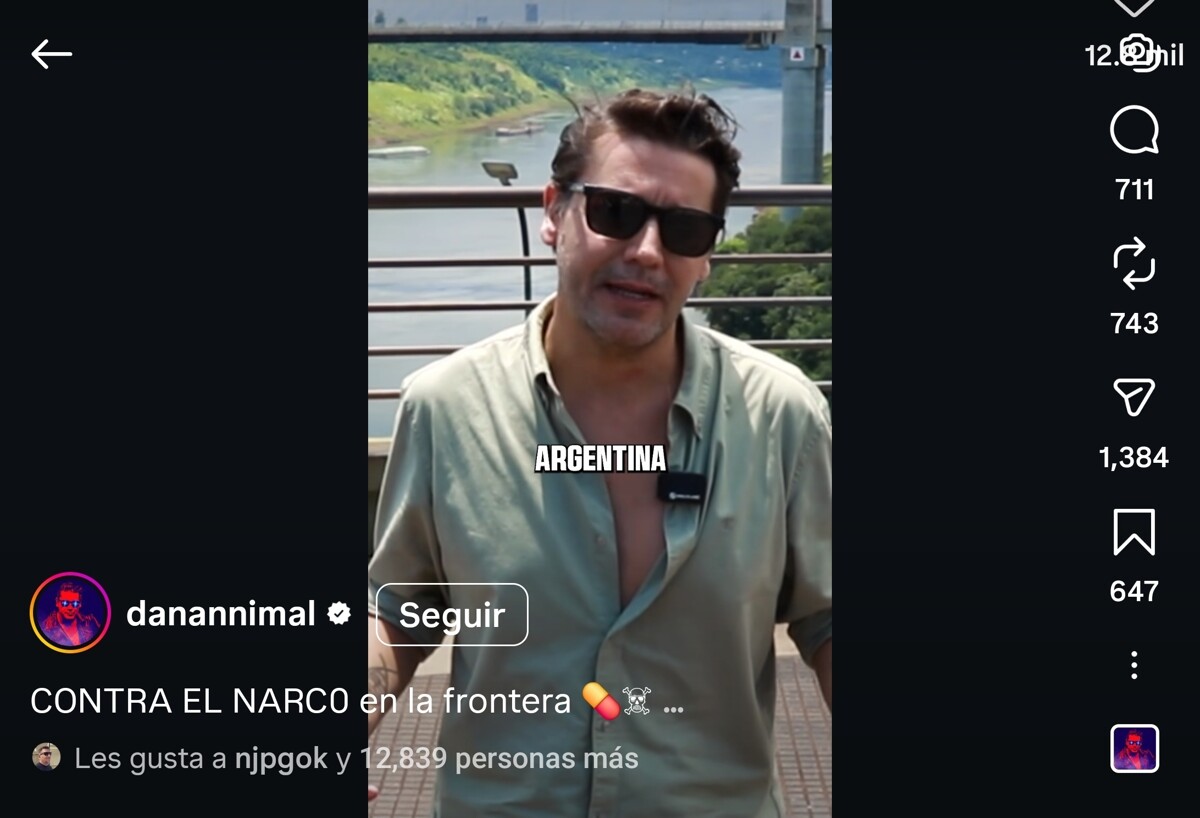
When a border becomes chronically porous, crime stops hiding and begins to be managed as a landscape. The numbers on regional smuggling are also alarming. Puerto Iguazú - March 14, 2026 - Total News Agency - TNA - Emanuel Danann's tour of the Triple Border once again brought to the forefront a reality that the region has known for years but which seems too often to have become normalized: the daily transit of smuggled goods, the circulation of so-called 'smugglers' through informal trails and paths, and the persistence of a parallel economy that coexists with legal commerce, erodes tax collection and feeds money laundering and organized crime structures. The most unsettling aspect of the material disseminated by Danann is not only what it shows, but what it suggests. The border cannot continue to be a territory where everyone knows what is happening but no one seems willing to cut to the root the mechanisms that sustain smuggling and money laundering. The discussion, in the end, is no longer just about denouncing the existence of smugglers or the movement of goods outside of controls. It shows trails, paths, and circuits that should not surprise anyone in the State. That same report places Ciudad del Este as a central hub for counterfeit goods and cigarettes that then enter Argentina and Brazil illegally, with profits that also finance other illicit activities, including drug trafficking. On the financial front, international concern is not new either. If those paths are visible to a journalist or an influencer, they should be far more visible to the Gendarmerie, Prefecture, Customs, Immigration, local police, and criminal intelligence agencies. The criticism is not aimed at an isolated episode, but at a structural failure in an area where economic crime long ago ceased to be marginal and has become a border routine. Official and regional reports have been warning about this vulnerability for some time. In the adjacent Brazilian region, a report by Agência Brazil described that the most common crimes in Foz do Iguaçu are precisely smuggling and customs fraud, and cited officials who acknowledge that some shipments of cell phones can reach up to 5 million reais. To this is added the human volume of the corridor. It means admitting that behind these routes there is an illegal economy of enormous scale, connected to financial networks, logistical structures, and gray areas of complicity or state impotence. This massive flow makes it physically impossible to inspect everyone who crosses individually and explains why networks that mix with daily life, shopping tourism, and informal commerce thrive. If a communicator can display the roads, crossings, and circuits used to move goods outside of formal controls, it becomes inevitable to ask to what extent Argentine, provincial, and federal authorities are truly unaware of these routes. Argentina's National Risk Assessment had already pointed out that the Triple Border area between Argentina, Brazil, and Paraguay requires specific attention in terms of asset laundering and illicit financing, and links it to smuggling, customs evasion, drug trafficking, and arms trafficking. The 2025 profile of the Global Organized Crime Index on Paraguay maintains that the illicit trade in taxable goods in one of South America's largest countries reached an estimated value of billions of dollars. In May 2025, ARCA reported that Customs prevented a smuggling operation of technological goods valued at over 41 million pesos in Puerto Iguazú, with products hidden in a double-bottomed vehicle. That case was just a snapshot of a much larger problem. And if they are known, the question becomes even harder: why do they continue to function with such normality. In 2025, the United States Department of State offered up to 10 million dollars in reward for information on Hezbollah's financial networks in the Triple Border, maintaining that in that region, schemes of money laundering, smuggling, and other sources of illicit revenue persist. More than 30,000 people cross the bridge connecting Foz do Iguaçu with Puerto Iguazú every day, and another 100,000 transit the Friendship Bridge between Brazil and Paraguay, according to data collected by Brazilian public television. But that it is difficult does not mean it should be accepted as a fatality. The data reinforces something that many in the region prefer to downplay: not only cheap goods or opportunistic merchandise are trafficked there, but also opaque funds circulate that can feed much more complex and dangerous criminal structures. In this context, Danann's contribution is uncomfortable because it breaks a widespread comfort. In parallel, GAFILAT documents emphasize that in that area, intense foreign trade, cash movements, and the storage of funds and assets converge, an ideal combination for money laundering schemes to find fertile ground. The magnitude of the phenomenon is not reduced to hypotheses. And when that map can be shown with a camera and a phone, the excuse of ignorance begins to sound too weak.